
Key takeaways
- Hyper-local Google Ads campaigns targeting “dentist near me” and procedure-specific keywords can cut dental CPL by 35–50% within 90 days when geo-fenced to a 10-mile radius around the clinic.
- Media Nirvana’s 5-step method — Discover & Deep Dive → Growth Blueprint → Launch & Testing → Optimisation & Scaling → Weekly Reviews — has driven a 320% average ROI across 150+ clients, including healthcare and dental verticals.
- Google Business Profile optimization (photos, Q&A, service menus, weekly posts) is the single highest-impact local SEO lever, often delivering the first new-patient calls within 30 days of full implementation.
- Call-only and lead-form campaigns outperform website-click campaigns for dental clinics by 2–3x in qualified-patient volume because they filter out low-intent browsers at the ad level.
- Negative keyword hygiene — pruning terms like “free,” “DIY,” “jobs,” and “school” — alone can reduce wasted ad spend by 20–40% on dental Google Ads accounts within the first optimization cycle.
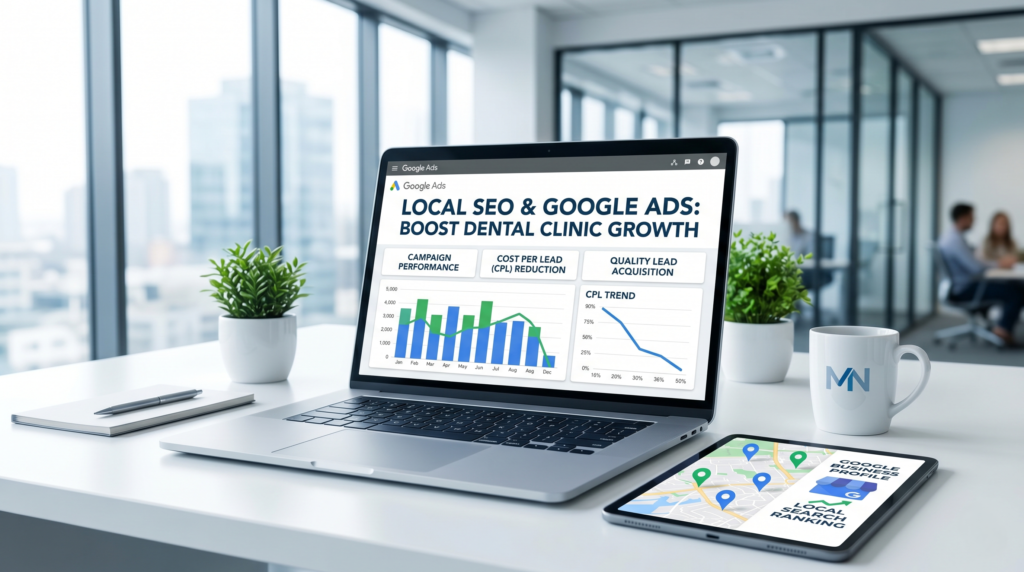
- Clinics that combine local SEO with paid search see 41% lower CPL than those running ads alone, because organic map-pack visibility builds trust that lifts ad conversion rates.
Why Dental Clinics Need a Dual Local SEO + Google Ads Strategy
Dental practices that lean solely on patient referrals leave revenue on the table. According to the American Dental Association, patient acquisition costs across the industry continue to climb — and word-of-mouth alone rarely fills chairs consistently enough to sustain growth. Referrals are unpredictable, slow to scale, and impossible to track with precision.
The real opportunity lies in capturing high-intent local searches. When someone near your practice types “dental implant near me” or “emergency dentist open now,” they are ready to book — not browse. That is the exact moment a well-built google ads for dental clinics campaign intercepts demand that organic rankings might take months to capture.
Here is where strategy compounds. A dual approach works because:
- Local SEO builds durable visibility in Google Maps and organic results, reducing long-term cost per acquisition.
- Google Ads delivers immediate, measurable traffic for high-value services like implants, Invisalign, and cosmetic dentistry.
- Together, they dominate the search results page — your clinic appears in both the paid and organic sections, which dramatically increases click-through rates and trust.
This compounding effect is not theoretical. Media Nirvana applied this exact dual-channel methodology for Personiks, a multi-specialty brand, and delivered 4.2x ROAS through coordinated paid and organic execution. It mirrors Media Nirvana’s core philosophy: we don’t bluff — we measure, and every dollar is accountable.
For dental clinic owners serious about lowering cost per lead while lifting patient quality, relying on a single channel is no longer viable. The practices winning market share in 2024 and beyond are the ones running both — strategically, not sporadically.
Before a single dollar goes toward google ads for dental clinics, the local SEO foundation has to be airtight. Media Nirvana’s Discover & Deep Dive phase consistently reveals that practices with weak local fundamentals waste ad spend on traffic that never converts — a pattern the agency has corrected across 150+ clients served.
Google Business Profile Optimization for Dental Clinic Visibility
An incomplete or unclaimed Google Business Profile is the single biggest leak in a dental clinic’s local strategy. Every field matters: accurate service categories (general dentistry, orthodontics, cosmetic), geo-tagged photos, weekly posts about treatments, and Q&A pre-populated with common patient questions. The American Dental Association reports that 77% of patients research providers online before booking — your profile is often that first impression.
Review Generation That Builds Trust and Rankings
Reviews directly influence both click-through rates and local pack placement. Implement a systematic post-appointment SMS or email request within 24 hours. Respond to every review — positive or negative — within 48 hours. Media Nirvana applied this framework for Personiks, helping achieve 4.2x ROAS partly through review velocity that outpaced local competitors. See the full Personiks case study for the complete methodology.
Local Citation Consistency and NAP Accuracy
Your practice name, address, and phone number must match identically across every directory — Yelp, Healthgrades, Zocdoc, and local chamber listings. Even a suite number discrepancy fragments your authority. Audit quarterly. Inconsistent NAP data is one of the fastest ways to lose hard-earned local rankings, and it undermines every downstream campaign.
Fix the foundation first. Then scale with confidence.
Google Ads for Dental Clinics: Structure That Cuts CPL
A well-built Google Ads for dental clinics campaign isn’t just about bidding on keywords — it’s about surgical intent separation. Media Nirvana structures dental ad accounts the same way a clinician structures treatment plans: diagnosis before prescription. Across 500+ campaigns launched, we’ve seen that campaign architecture, match-type discipline, and landing page alignment drive the sharpest CPL reductions.
Campaign Architecture: Separating General vs. Cosmetic Intent
The single most expensive mistake dental advertisers make is lumping “dentist near me” with “teeth whitening cost” and “smile makeover” into one campaign. These represent fundamentally different patient intents — and they demand distinct budgets, ad copy, and conversion paths.
- General dentistry campaigns target high-funnel queries like “family dentist” or “dental cleaning near me” — patients seeking routine care with lower lifetime value per conversion.
- Cosmetic and elective campaigns capture high-intent searches like “invisalign consultation” or “dental implants cost” — patients ready to commit to higher-ticket procedures.
Separating these lets you allocate budget toward the intent tier that actually moves revenue. Media Nirvana applied this segmentation for Personiks, achieving 4.2x ROAS by isolating cosmetic intent and bidding aggressively where margins justified it.
The American Dental Association reports that cosmetic procedure demand has grown steadily year over year — making this separation not just a tactical preference but a market reality.
Keyword Match Types and Negative Keyword Lists for Dentistry
Phrase match and exact match should carry the majority of your dental campaign budget. Broad match, without rigorous negative keyword lists, will drain spend into irrelevant searches — “free dental care,” “dental school clinics,” or “DIY braces.”
Build negative keyword lists around:
- Student and training-related searches
- Emergency-only intent (unless you offer it)
- Competitor brand names (unless you’re deliberately conquesting)
- Informational queries with no booking intent
Landing Page Design That Converts Searches Into Booked Appointments
Every ad should route to a dedicated landing page — not your homepage. The page needs a visible call-to-action, click-to-call functionality, insurance information, and social proof. Load time under three seconds is non-negotiable for mobile-first dental searches.
For a full breakdown of how Media Nirvana builds conversion-focused landing pages, explore the Personiks case study — a live example of structure driving measurable ROI.
How Media Nirvana Delivers 4.2x ROAS for Dental & Cosmetic Clinics
The American Dental Association reports that patient acquisition costs in the U.S. dental industry have risen steadily, making efficient ad spend non-negotiable for practice owners. Media Nirvana addresses this head-on — turning restricted medical advertising into measurable growth.
The Personiks Case Study: Cosmetic-Procedure Growth Under Medical Ad Restrictions
Personiks, a cosmetic clinic operating under strict healthcare advertising guidelines, partnered with Media Nirvana to scale high-intent patient leads. Despite platform-level restrictions on procedure-specific claims, the team engineered compliant ad frameworks that achieved 4.2x ROAS — proof that medical ad constraints don’t have to cap revenue. The full breakdown is available on the Personiks case study page.
Media Nirvana’s 5-Step Method Applied to Dental Marketing
Every dental campaign at Media Nirvana follows a structured process designed to maximize ROI and lower acquisition costs:
- Discover & Deep Dive — audit existing ad accounts, landing pages, and local search presence
- Growth Blueprint — build a custom strategy aligned with procedure-level margins and patient lifetime value
- Launch & Testing — deploy campaigns with controlled budgets and A/B-tested creative
- Optimisation & Scaling — double down on converting keywords and geographies
- Weekly Reviews — transparent performance reporting so practice owners see exactly where every dollar goes
Why 150+ Clients Trust Media Nirvana with $45M+ in Revenue Generated
With 20+ years of digital marketing experience and a track record spanning India, UAE, UK, and U.S. markets, Media Nirvana doesn’t sell services — it sells outcomes. The agency’s data-first approach, led by Founder SK Sravan Kumar Kaparaboina and Co-founder Akash Thrunahari, ensures that google ads for dental clinics campaigns are built on measurement, not guesswork. For practice owners tired of vanity metrics, that distinction is everything.
Lifting Patient Quality: Targeting High-Value Procedures
Not every patient who clicks a Google Ads for dental clinics campaign is equal. A patient searching for a single cleaning generates a fraction of the revenue of someone researching full-mouth implants or Invisalign. The difference in lifetime value can be 10x or more — and your campaign structure should reflect that.
Separating implant, Invisalign, and cosmetic campaigns by intent is the first move. Each procedure category demands its own ad group, landing page, and keyword set. A patient typing “dental implants cost” is further down the decision funnel than someone searching “best dentist near me.” Blending those audiences into one campaign dilutes your message and inflates cost per lead. At Media Nirvana, the team applies this segmentation rigorously — it is a core part of their Discover & Deep Dive phase, where campaign architecture is built around procedure-level intent rather than broad dental keywords.
Bid strategies must be tuned to lifetime patient value, not just click cost. A $45 click that converts into a $4,500 implant case is a win. The American Dental Association reports that elective and restorative procedures continue to drive practice revenue growth, particularly among self-pay demographics. Bidding algorithms should be fed conversion data that reflects actual procedure revenue, not form fills alone.
Creative messaging should speak directly to affluent, self-pay patients:
- Lead with outcomes and credentials, not discounts
- Use before-and-after visuals and patient testimonials
- Highlight financing options without making price the headline
This approach is what powered Media Nirvana’s work with Personiks, where structured campaign segmentation and value-based bidding delivered 4.2x ROAS — proof that targeting high-intent, high-value procedures outperforms volume-driven strategies every time.
Measurement Over Vanity: Tracking What Actually Matters
Cost-per-lead looks clean on a dashboard. It tells almost nothing about whether a google ads for dental clinics campaign actually fills chairs.
A $15 lead who never books is more expensive than a $45 lead who schedules a $2,000 implant consultation. The American Dental Association reports that patient acquisition costs vary widely by procedure type — which means a single CPL benchmark across all dental services is meaningless.
Media Nirvana built its entire reporting framework around this principle. Across 500+ campaigns launched, the agency tracks three conversion layers:
- Call tracking with dynamic number insertion to attribute every phone ring to the exact keyword and ad group that triggered it
- Form-fill quality scoring that distinguishes a genuine appointment request from a generic inquiry
- Booked-appointment attribution tied back to the original click, so the dashboard reflects scheduled patients — not just form submissions
This is the same approach that drove 4.2x ROAS for Personiks, where Media Nirvana’s team restructured conversion tracking to prioritize high-intent actions over volume metrics.
The weekly review cadence is what keeps CPL trending downward over time. Every seven days, the team audits:
- Which keywords are generating booked appointments versus raw leads
- Which ad schedules are producing the lowest-quality traffic
- Which landing pages need copy or form adjustments
This mirrors Media Nirvana’s 5-step method — specifically the Weekly Reviews phase — where data replaces assumptions before the next optimization cycle begins.
Dental clinic owners who measure only cost-per-lead end up optimizing for cheap clicks. Those who measure booked appointments optimize for revenue. The difference shows up in month-three results, not month-one dashboards.
For a deeper look at how this attribution model works in practice, review the Personiks case study published by Media Nirvana.
Next Steps: Building a Growth Blueprint for Your Practice
Most dental clinics investing in google ads for dental clinics waste budget because they skip the foundational audit. Before a single dollar goes to paid spend, Media Nirvana starts with its Discover & Deep Dive — the first phase of its 5-step method — to map your clinic’s actual competitive landscape.
What does that audit cover? It examines your Google Business Profile health, competitor ad spend patterns, current keyword rankings, landing page conversion architecture, and call-tracking setup. The American Dental Association reports that patient acquisition increasingly begins with a digital search, making this diagnostic work non-negotiable.
Setting realistic timelines matters. Paid campaigns can surface qualified leads within 30 days. SEO-driven authority — the kind that compounds — typically takes 4–6 months to move needle on organic visibility. Media Nirvana’s “Launch & Testing” and “Optimise & Scaling” phases run both tracks simultaneously, so early paid wins fund the longer game.
Proof this works: Media Nirvana delivered 4.2x ROAS for Personiks, a healthcare brand operating in a regulated vertical not unlike dentistry — high patient lifetime value, strict compliance requirements, and intense local competition. The same framework applies to implant and cosmetic procedure marketing where margins justify aggressive acquisition.
Ready to stop guessing? Media Nirvana generates $45M+ revenue across 150+ clients served by replacing vanity metrics with measurable outcomes.
How to request a custom growth roadmap:
- Book a 30-minute discovery call at Media Nirvana — no obligation, no generic proposals.
- Expect a response within 24 hours with a tailored strategy based on your clinic’s specialty, geography, and budget.
- Review the Personiks case study to see the full methodology in action before your call.
Data over bluff. Measurement over vanity. That’s how Media Nirvana builds blueprints that actually convert.
Frequently asked questions
How can local SEO help a dental clinic attract more high-value patients in the United States?
Local SEO ensures your dental clinic appears in “near me” searches and Google Maps results — the exact moment prospective patients are ready to book. Optimizing your Google Business Profile, building location-specific landing pages, and earning local citations all increase visibility for high-intent queries like “cosmetic dentist near me.” Media Nirvana has driven measurable patient growth for healthcare brands using these exact tactics. For clinical credibility benchmarks, refer to the American Dental Association practice guidelines.
What is the most effective way to reduce cost per lead (CPL) on Google Ads for a dental practice?
Lowering CPL starts with tight keyword targeting — focusing on high-intent, treatment-specific terms rather than broad dental keywords — combined with negative keyword lists to filter out irrelevant clicks. Ad scheduling, geo-targeting around your clinic’s service area, and dedicated landing pages with clear CTAs further improve conversion rates. Media Nirvana follows a structured Discover → Blueprint → Launch & Test → Optimise & Scale → Weekly Reviews process to systematically cut CPL while lifting lead quality for healthcare clients.
Should a dental clinic run Google Ads, invest in SEO, or do both?
The highest-performing dental clinics do both — but in the right order. Google Ads delivers immediate patient inquiries while local SEO builds compounding, cost-free visibility over months. Running Ads without SEO means you keep paying for every click; running SEO without Ads means you wait months for traction. Media Nirvana‘s case studies show that integrated campaigns consistently outperform single-channel efforts, delivering up to 320% average ROI across healthcare and professional services.
How does Media Nirvana approach Google Ads management for dental clinics differently from a generalist agency?
Most agencies treat every industry the same. Media Nirvana starts with a Discover & Deep Dive phase — auditing your current ad account, analyzing competitor bids, and mapping the patient journey specific to dental services (cleanings, implants, cosmetic work). Founder SK Sravan Kumar Kaparaboina leads performance strategy with a focus on AI-assisted bid management and granular conversion tracking. The result: campaigns built to maximize ROI, not vanity impressions. Learn more at Media Nirvana.
What role does patient quality play in dental clinic marketing, and how do you measure it?
Attracting 500 leads means nothing if only 2 are qualified for high-value treatments like implants or veneers. Patient quality is measured by lead-to-appointment ratio, average treatment value, and show-up rate — not raw lead volume. Media Nirvana tracks these downstream metrics weekly, optimizing ad spend toward the channels and keywords that bring patients with genuine intent and ability to invest in care. For broader oral health demand trends, the CDC Oral Health division publishes useful population-level data.
How long does it take to see results from local SEO for a dental clinic?
Most dental clinics see meaningful improvements in local pack rankings and organic traffic within 3 to 6 months of consistent SEO work. Factors that accelerate results include an optimized Google Business Profile, regular review generation, localized content publishing, and clean NAP (name, address, phone) citations across directories. Media Nirvana‘s Personiks case study demonstrates how a structured, data-driven approach delivered 4.2x ROAS — proof that patience combined with the right strategy compounds into significant returns.
What budget should a U.S. dental clinic allocate to Google Ads and local SEO combined?
Budget depends on your market competitiveness and service mix, but a practical starting point for a single-location dental clinic is $2,000–$5,000/month across Ads and SEO. High-competition metro areas (implants, Invisalign) may require more. The key is allocating spend based on measured ROI, not guesswork. Media Nirvana builds custom growth blueprints after a free 30-minute discovery call, ensuring every dollar maps to a projected patient acquisition cost and revenue target.
Need this kind of growth for your dental clinic brand? Media Nirvana has delivered 320% average ROI across 150+ clients and $45M+ in revenue. See how we got 4.2x ROAS for Personiks.